INQUIRY
Inquiry
Form loading...

7 Tips for Choosing Industrial Aluminum Profiles?

Choosing an Industrial Aluminum Profile is not a catalog exercise. It is a design decision that affects load capacity, fit, corrosion resistance, and assembly time. A profile that looks substantial may still flex under a long span or fail around a concentrated load. Small details matter: wall thickness, slot dimensions, alloy, temper, and connector type.

The International Aluminium Institute’s 2021 report, Aluminium for Climate, projects that global aluminum demand could rise by nearly 40% by 2030 compared with 2019. That growth makes material efficiency and sound specification increasingly important. The report does not choose a profile for your project, of course. Your operating conditions do. Consider vibration, moisture, temperature changes, machining needs, and the weight of attached equipment. A neat catalog number can still mislead.

As Dr. John Weritz, the Aluminum Association’s vice president for standards and technology, has emphasized: “Aluminum is infinitely recyclable without losing its essential properties.” That principle supports thoughtful material use, but it does not mean every profile performs equally. Check supplier drawings, alloy and temper documentation, dimensional tolerances, and load data before ordering. In practice, asking for a sample can reveal fit problems that a screen cannot. Seven practical tips can help you compare profiles, confirm specifications, and avoid costly changes after installation. One detail is easy to miss: the best choice is not always the lightest one.
7 Tips for Choosing Industrial Aluminum Profiles?

Define the Application and Operating Conditions

Before comparing industrial aluminum profiles, define the job the structure must perform. Will it support a guarded machine, a conveyor, or a lightweight inspection station? Each application creates different demands. Record the load, span, mounting points, and expected movement. A frame carrying a steady 40-kilogram fixture behaves differently from one exposed to repeated vibration. “Light duty” is not a useful specification. Include the equipment’s weight and how that weight reaches the frame.

Operating conditions matter just as much. Note temperature ranges, moisture, cleaning chemicals, dust, and nearby heat sources. A profile used in a dry assembly area may perform poorly near washdown equipment. Check whether connectors, fasteners, and panels face the same exposure. Also consider installation access: a strong design can still be difficult to assemble when bolts are blocked by adjacent machinery. Small details are easy to miss. Recheck assumptions with the people who will install and maintain the structure.

Tips: Write down the load and support spacing. Photograph the installation area, including overhead obstructions. Ask whether vibration or future equipment changes are likely. If conditions are uncertain, say so; choosing a profile from an incomplete brief can create avoidable redesigns.

Select the Aluminum Alloy and Temper

Alloy and temper shape an aluminum profile’s strength, surface finish, and response to machining. Start with the actual load, environment, and manufacturing steps—not a familiar alloy number. For architectural frames, 6063 is often selected for its extrusion detail and finish quality. For parts needing greater strength or machining, 6061 may be worth evaluating. These are starting points, not automatic answers.

Temper matters just as much. It describes how the alloy was processed and affects strength, hardness, and formability. A T6 temper can provide useful strength, but it may not suit every bending or forming operation. Check the profile supplier’s temper availability and request material documentation. Then compare published properties with the design loads and operating temperature. A small test section can expose issues that a data sheet misses. This step takes time, but skipping it can cost more later.

Tips: Tell the supplier how the profile will be cut, drilled, bent, and finished. Confirm the alloy and temper on the order documents. Avoid choosing by strength alone; the trade-off is rarely tidy.

Determine Profile Shape, Dimensions, and Wall Thickness

Choosing an industrial aluminum profile starts with its job, not its catalog appearance. A rectangular tube may resist bending well in one direction, while a T-slot profile offers flexible mounting points. For a machine guard, easy panel attachment may matter more than maximum stiffness. For a moving frame, weight and resistance to twisting can be more important. Sketch the loads and connection points before comparing shapes. It saves guesswork.

Dimensions affect fit, strength, and assembly. Check the overall width and height, slot openings, and corner geometry against your brackets and fasteners. A profile that looks close may still leave too little room for a connector or cable. Measure the available space, including clearance for installation tools. Small details matter. If the structure carries a load, estimate its direction and span, then check deflection as well as strength. A frame can stay intact yet flex enough to misalign a sensor.

Wall thickness influences stiffness, mass, and machining options, but thicker is not automatically better. Consider how the profile will be cut, drilled, joined, and supported. Thin walls may deform around a clamp; heavier walls can add cost and weight without solving a poorly placed support. I would verify the proposed section against real load data and the supplier’s dimensional drawings. Early estimates are useful, but they are not a substitute for testing the assembled frame. We sometimes focus too much on thickness and overlook the joint.

Evaluate Surface Finish and Manufacturing Quality

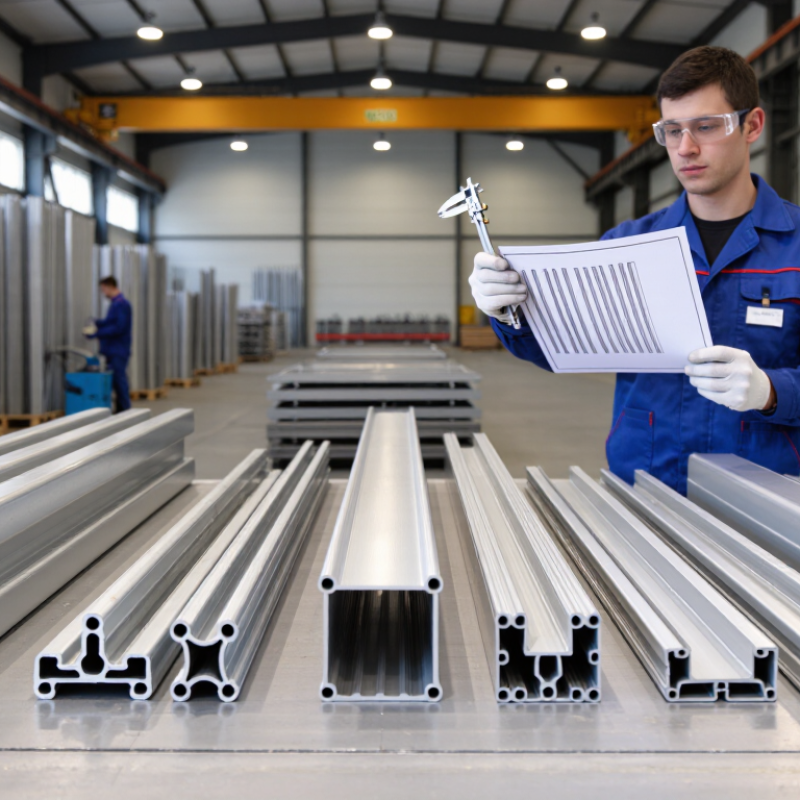
Evaluate surface finish under consistent lighting, not beside a showroom window. Look for scratches, die lines, pits, and uneven anodized color. Look closely. Check several points along the extrusion, including cut ends and corners, where handling marks often appear. A polished sample can still hide inconsistent coating thickness or dimensional variation. Appearance alone is not enough.

Ask for the specified finish and coating thickness, then verify them with suitable measuring equipment and documented inspection records. Compare dimensions with the drawing and applicable requirements, such as ASTM B221 for extruded aluminum products. The International Aluminium Institute reports that recycling aluminum uses about 5% of the energy needed for primary production. That makes avoidable stripping and rework worth considering when assessing finish quality. Still, a low-defect appearance does not prove a profile will perform well in service. Check samples from more than one production run, and clarify acceptance criteria before ordering. A detail people sometimes miss: the inspection method itself can affect what defects are visible.

7 Tips for Choosing Industrial Aluminum Profiles: Evaluate Surface Finish and Manufacturing Quality

Reference surface-roughness values for common ISO roughness grades. Lower Ra values indicate a smoother surface; confirm the required finish on the product drawing and verify it with suitable inspection.

Reference values: ISO roughness grade series. Actual profile finish depends on the manufacturing process and specified requirements.

Compare Suppliers, Certifications, and Total Cost

When comparing industrial aluminum profile suppliers, request the same evidence from each: alloy and temper, dimensional tolerances, inspection records, and current certificates. ISO 9001 can indicate a documented quality system, but it does not prove that a particular extrusion meets your drawing. Ask for certificate scope and expiry dates. Ask for proof. A supplier should also explain how it controls die wear, straightness, surface finish, and batch traceability. A small sample is useful; measure it yourself before approving production.

Compare the landed cost, not just the price per kilogram. Include machining, anodizing, packaging, freight, minimum order quantities, and the cost of rejected parts. The International Aluminium Institute’s aluminium recycling guidance states that remelting uses about 5% of the energy required to produce primary aluminium. That figure makes recycled content worth asking about, though it does not guarantee consistent alloy performance or lower delivered cost. Request documented recycled-content figures and confirm the material specification. Lead time matters, too: a cheaper profile that arrives late can stall assembly and add labor costs. Put quotes into one table, but leave room for judgment. Supplier promises can look tidy on paper; a trial order may reveal uneven finishes, damaged corners, or packaging that needs work.

7 Tips for Choosing Industrial Aluminum Profiles? - Compare Suppliers, Certifications, and Total Cost

Tip What to Compare What to Verify Why It Matters
1. Match the alloy and temper to the application Alloy designation, temper, strength requirements, corrosion exposure, and machining or forming needs. Request the exact alloy and temper on the quotation and material certificate. Common extrusion alloys include 6060 and 6063 for many architectural and general-purpose profiles, and 6061 for applications that require higher strength. Choosing by alloy number alone can be misleading: mechanical properties depend on both alloy and temper. An unsuitable specification can affect strength, finish, machinability, and service life.
2. Compare dimensional control and applicable standards Profile dimensions, wall thickness, straightness, twist, cut length, and inspection method. Identify the required standard and edition in the purchase specification. EN 755 covers aluminium alloy extruded products, while EN 12020 specifies tolerances for certain precision extruded profiles. ASTM B221 covers extruded aluminium-alloy bars, rods, profiles, and tubes. Standards apply to defined product scopes and tolerances; they do not automatically guarantee that every custom feature meets your drawing. Confirm critical dimensions and acceptance criteria in writing.
3. Check quality-system evidence and traceability Quality-management processes, lot identification, inspection records, corrective actions, and change control. Ask for a current ISO 9001 certificate and verify its scope and validity with the issuing certification body. Request sample inspection reports and confirmation that production lots can be traced to material documentation. ISO 9001 is a quality-management-system certification, not a certification of a particular profile or its mechanical properties. Traceability and product-specific records help substantiate conformity.
4. Evaluate surface finish and treatment capability As-extruded, anodized, painted, or other specified finishes; appearance limits; coating thickness; and color consistency. Specify the finish, inspection method, and acceptance limits. For anodizing, ISO 7599 provides a framework for specifying decorative and protective anodic oxidation coatings on aluminium and its alloys. Confirm whether the supplier or a subcontractor performs the treatment. Finish quality can vary with alloy, extrusion, pretreatment, and process control. Written samples or approved reference panels reduce ambiguity, especially for visible components.
5. Compare tooling, minimum order, and lead time Die or tooling charges, ownership, storage, maintenance, minimum order quantity, sample lead time, and production lead time. Request a written tooling quotation that states what is included, who owns the die, how modifications are priced, and what happens if the tool is no longer used. Confirm lead times for both initial production and repeat orders. A low unit price may be offset by tooling costs, setup charges, or a large minimum order. Lead-time assumptions should include approval, extrusion, finishing, inspection, and delivery.
6. Compare landed cost, not just price per kilogram Profile price, tooling, finishing, cutting, packaging, freight, duties, inspection, scrap, and payment terms. Ask suppliers to quote the same drawing, alloy, temper, finish, order quantity, delivery term, and packaging requirement. Compare total delivered cost and clarify whether quoted weight is theoretical or measured. Different quote assumptions make unit-price comparisons unreliable. A consistent scope reveals the cost of the finished, usable part rather than only the raw extruded material.
7. Confirm supply continuity and practical support Production capacity, backup arrangements, communication, engineering support, packaging, and delivery performance. Ask how forecast changes, nonconforming material, drawing revisions, and urgent replenishment are handled. For critical projects, review delivery records or begin with a production trial and agreed inspection plan. Responsive technical support and dependable replenishment can reduce delays and rework. Evaluate service using documented performance and project-specific requirements, rather than promises alone.

Note: Standards and certification requirements depend on the product, market, and contract. Confirm the applicable specification and current standard edition before placing an order.